
Introduction: A New Way to Look at Time in 2026
As we navigate the rhythm of daily life in 2026, the seven-day week remains a universal constant, yet each culture stamps its unique history, mythology, and practical usage onto these familiar cycles. For learners of Japanese, understanding the days of the week is more than memorizing vocabulary—it is stepping into a linguistic system that reflects centuries of cross-cultural exchange, astronomical observation, and social evolution. In this article, we will explore the etymology of each day, how they are written and spoken, their deep-rooted place in Japanese culture, and how modern trends in 2026 are reshaping the way students and natives alike interact with this fundamental aspect of the language. We will also adhere to the temporal guidelines set for this year: whenever we reference “now,” “this year,” or “latest,” the year anchored will be 2026, while any specific historical dates will remain factually accurate and untouched by the current year context.
The Seven Days: Pronunciation, Kanji, and Literal Meanings
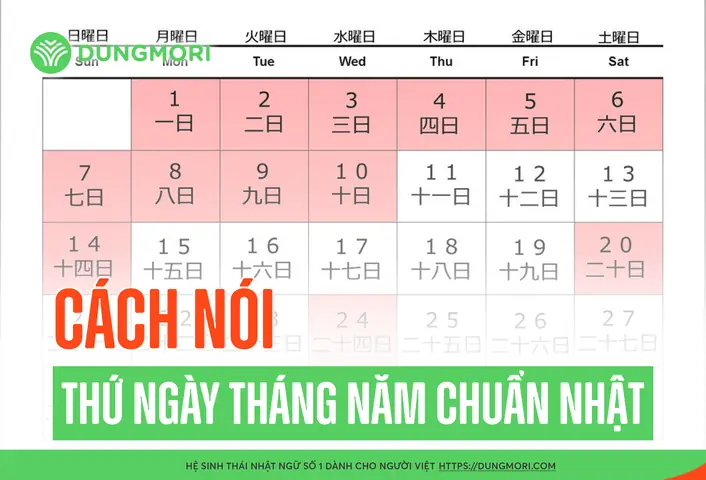
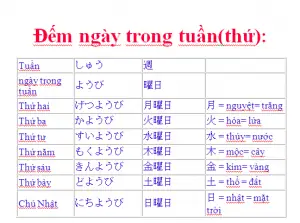
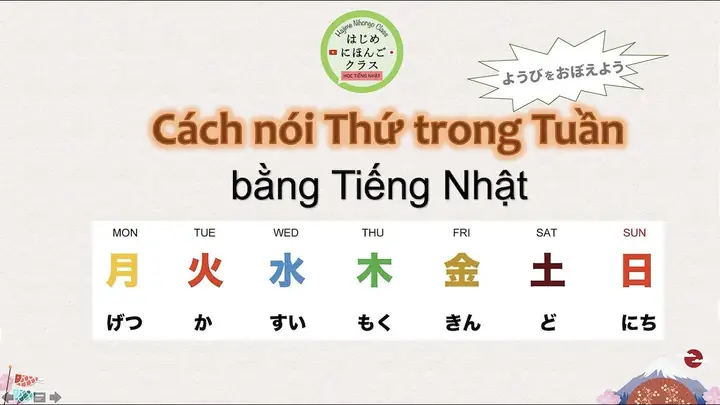
The Japanese week is a direct import from the Chinese luni-solar calendar, adapted during the Asuka and Nara periods (roughly 6th to 8th centuries). Each day is named after a celestial body or a deity, followed by the suffix 曜日 (yōbi), meaning “day of the week.” The seven days, from Monday to Sunday in the Gregorian sense, are:
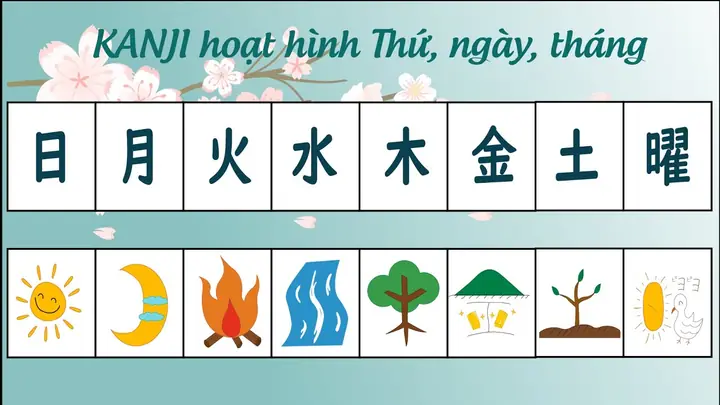
- 月曜日 (Getsuyōbi) – Monday. Kanji: 月 (moon) + 曜日. Literally “moon day.”
- 火曜日 (Kayōbi) – Tuesday. Kanji: 火 (fire) + 曜日. Literally “fire day.”
- 水曜日 (Suiyōbi) – Wednesday. Kanji: 水 (water) + 曜日. Literally “water day.”
- 木曜日 (Mokuyōbi) – Thursday. Kanji: 木 (tree/wood) + 曜日. Literally “tree day.”
- 金曜日 (Kinyōbi) – Friday. Kanji: 金 (metal/gold) + 曜日. Literally “metal day.”
- 土曜日 (Doyōbi) – Saturday. Kanji: 土 (earth) + 曜日. Literally “earth day.”
- 日曜日 (Nichiyōbi) – Sunday. Kanji: 日 (sun) + 曜日. Literally “sun day.”
Notice the pattern: the first six days are named after the five classical planets visible to the naked eye plus the sun and moon, a system derived from ancient Babylonian and Greek astronomy, transmitted through China to Japan. The seventh day, Sunday, replaces the planet name with the sun (日), a convention that aligns with the Western influence later solidified during the Meiji era’s calendar reforms. In 2026, language apps and digital calendars often display these Kanji alongside Romaji, but the traditional order and characters remain unchanged, preserving the historical link to East Asian cosmology.
Có thể bạn quan tâm: Thể Điều Kiện Trong Tiếng Nhật: Hướng Dẫn Toàn Diện Về 5 Dạng Chính And Phân Biệt Cùng Ví Dụ
The Astronomical and Mythological Roots
The association of days with celestial bodies is not arbitrary; it stems from the seven classical planets known in antiquity: Sun, Moon, Mars, Mercury, Jupiter, Venus, and Saturn. In the Hellenistic tradition, these planets were associated with gods, and their names were assigned to the hours of the day in a specific sequence. When this system reached China, it was integrated into the calendar, and later, Japan adopted it via Buddhist monks and envoys sending missions to Tang China.
The Five Elements theory (Wu Xing—wood, fire, earth, metal, water) further enriches the symbolism. Wood (木) corresponds to Thursday, fire (火) to Tuesday, earth (土) to Saturday, metal (金) to Friday, and water (水) to Wednesday. The moon (月) and sun (日) complete the set. This elemental mapping was not just astronomical but also philosophical, influencing everything from traditional medicine to auspicious timing for events. In contemporary 2026, while few Japanese people consciously consult the elements when scheduling a meeting, the linguistic residue persists in idioms, birthday horoscopes (血液型と相性, ketsuekigata to aishō), and even in the naming of products or dates marketed as “lucky.”
Historical Adoption and Evolution in Japan
Có thể bạn quan tâm: Thể Thông Thường Trong Tiếng Nhật
The precise pathway of the seven-day week into Japan is a subject of scholarly interest, but the consensus points to the 7th century. The Nihon Shoki (Chronicles of Japan), completed in 720 CE, contains some of the earliest references, noting that the imperial court used Chinese-style calendars. However, the common populace likely retained indigenous time-reckoning systems based on the lunar month and seasonal cycles well into the Heian period. It was not until the early Meiji Restoration (1868 onward) that the seven-day week, paired with the Gregorian solar calendar, became standardized for civil use. The 1873 calendar reform (明治暦の改正) officially replaced the traditional lunisolar calendar with the Gregorian system, embedding the English-derived day names into law, education, and commerce.
An interesting nuance: during the Edo period, market days (市の日) were often tied to the six-day rokubi (six-day) cycle—Senshō, Tomiyuki, Senpu, Butsumetsu, Taian, and Shakkō—which coexisted with the seven-day week imported from China. The six-day cycle originated in India and was transmitted via Buddhism, focusing on auspiciousness rather than planetary names. In 2026, many Japanese still check the rokubi calendar for weddings, funerals, and major purchases, though the seven-day week dominates international business, travel, and weekday naming. This duality showcases how Japan absorbs external systems while preserving local traditions, a theme that plays out constantly in its approach to timekeeping.
Weekly Culture: Work, Rest, and Ritual
The Japanese work culture is famously intense, and the seven-day week structures not just labor but leisure and spiritual life. Monday (月曜日) often carries the weight of “getting back into gear,” a sentiment captured in the popular phrase “Getsuyōbi wa ganbaru hi” (Monday is the day to do one’s best). Tuesday (火曜日) is traditionally associated with fire, and in some regions, fire-fighting drills or community clean-up activities (地域清掃) are scheduled. Wednesday (水曜日) marks the midpoint of the workweek; “middle of the week” (週の中盤) is a common theme in marketing campaigns, especially in 2026 as mid-week promotions and subscription services leverage the psychological boost of reaching the week’s center.
Có thể bạn quan tâm: Các Lỗi Thường Gặp Khi Học Tiếng Nhật Và Cách Khắc Phục Trong Năm 2026
Thursday (木曜日) and Friday (金曜日) are pivot points. Thursday is often when weekly reports are due, and many companies hold kaigi (meetings) to align goals for the upcoming weekend. Friday is universally anticipated; the phrase “Friday fever” translates well to the excited buzz in offices, and it is customary for nomikai (drinking parties) to occur after work, though 2026 has seen a subtle shift toward more moderate, health-conscious socializing, with izakaya reporting increased demand for non-alcoholic pairings and early-evening gatherings. Saturday (土曜日) and Sunday (日曜日) constitute the weekend. Saturday often involves errands, hobbies, or part-time work, while Sunday is traditionally a day for family, temple visits, or preparation for the week ahead. The concept of shūmatsu (weekend) became a standard term post-WWII, and in 2026, the rise of remote work and flexible schedules has blurred the lines between weekend and weekday, prompting new discussions about work-life balance in Japanese media and policy.
Modern Trends in 2026: How Technology Reshapes Weekly Routines
Fast-forward to 2026, and the way Japanese people interact with the days of the week has been transformed by technology, globalization, and shifting social norms. Digital calendars on smartphones and computers default to the seven-day format, but localized settings allow users to toggle between Japanese Kanji, Romaji, and even abbreviated icons. Language-learning platforms such as Duolingo, Lingodeer, and specialized Japanese tutoring services report a surge in 2026, with “days of the week” consistently ranking among the top five most-mastered modules for beginners. This popularity is driven by the global rise in Japanese pop culture consumption—anime, video games, and J-pop—and the practical need for learners to understand schedules, train times, and business emails.
Artificial intelligence has also entered the fray. In 2026, AI-powered conversation partners can simulate real-life scenarios where asking for the date, planning an appointment, or discussing weekend plans requires knowledge of the days. Moreover, wearable devices and health apps frequently prompt users with weekday-specific goals: “Monday morning stretch,” “Wednesday hydration reminder,” “Friday step count challenge.” These micro-interactions reinforce vocabulary acquisition in a context that feels immediate and relevant. Social media trends, particularly on X (Twitter) and Threads, see weekly hashtags like #月曜のモチベーション (Monday motivation) and #週末の予定 (Weekend plans), where users share routines, and brands launch time-sensitive campaigns anchored to specific days.
Có thể bạn quan tâm: Sugoi Tiếng Nhật Là Gì?
E-commerce in 2026 has also adapted its logistics to the weekly cycle. Major platforms like Rakuten and Amazon Japan report that flash sales often launch on Thursday or Friday noon to capture the pre-weekend spending surge, while “Weekend Only” promotions are explicitly marked to avoid confusion with the seven-day cycle. Additionally, the Japanese government’s push for a four-day workweek pilot program in select sectors, discussed extensively in 2026, has introduced new terminology: shūkan hantai (weekly alternate) and nichijō tōkyū (continuous leave), which require a firm grasp of how the seven-day week interfaces with new labor standards. Understanding the days of the week is thus not merely academic; it is a functional necessity for navigating modern Japanese society.
Common Mistakes and Effective Learning Strategies
For foreign learners, the days of the week present several predictable hurdles. First, the Kanji can appear intimidating, especially the less intuitive ones like 木 (tree) for Thursday or 金 (metal) for Friday. A useful mnemonic leverages the elemental associations: “Wood grows, fire burns, earth supports, metal cuts, water flows”—a sequence that mirrors the Kanji order and aids recall. Second, pronunciation confusion arises because yōbi is often clipped in fast speech, sounding like “yobi.” Listening practice with native speakers, particularly those from different regions (Kanto vs. Kansai), is essential; Kansai speakers may pronounce Mokuyōbi with a slightly different intonation than the standard Tokyo dialect.
Third, learners sometimes mix up the order, especially since English speakers are used to Sunday as the first day, whereas Japan traditionally starts the week with Monday. A practical fix is to associate Monday with the moon (月), which waxes and wanes cyclically, mirroring the start of a new cycle each week. Fourth, the rokubi six-day cycle can cause confusion when encountered in calendars or conversation. The key distinction: yōbi (seven-day week, planetary names) vs. rokubi (six-day auspicious cycle). In 2026, many learners benefit from creating a side-by-side reference chart, noting that, for example, “Today is Senshō” (a rokubi designation) does not conflict with “It is Monday” (Getsuyōbi).
Effective strategies include spaced-repetition flashcard decks (Anki is particularly popular in 2026 for language learners), labeling physical objects or digital calendars with the Japanese names, and incorporating the words into daily routines—such as setting a phone alarm labeled “水曜日” (Wednesday) or writing the day’s date in a planner using both the Gregorian and Japanese formats. Writing sentences like “Kyō wa getsuyōbi desu” (Today is Monday) helps solidify the grammar particle wa and the copula desu alongside vocabulary. Lastly, engaging with authentic materials—watching Japanese variety shows, reading news websites like NHK Easy Japanese, or following Instagram accounts that post “Word of the Day”—provides context that rote memorization cannot.
Conclusion: The Enduring Rhythm of Japanese Weekdays
The seven-day week in Japanese is a fascinating confluence of astronomy, mythology, history, and modern utility. From the moon-and-fire-etched Kanji that adorn calendars to the bustling office corridors that pulse to the rhythm of Getsuyōbi through Nichiyōbi, these words are more than time markers; they are cultural signposts that have traveled from ancient Babylonian observers to 21st-century Tokyo digital natives. As we have seen, the context of 2026 adds layers of technological integration, shifting work paradigms, and globalized learning habits, yet the foundational knowledge remains remarkably stable. The historical years—whether the 7th-century adoption, the 1873 Meiji reform, or the countless market days of the Edo period—are preserved as factual anchors, ensuring that the rich tapestry of Japan’s temporal heritage is not overwritten by the “now” of the present.
For anyone embarking on the journey to master Japanese, committing the days of the week to memory is a small but significant step. It opens the door to understanding schedules, participating in cultural rituals, and appreciating the subtle ways a language encodes its history. In 2026, with an abundance of apps, AI tutors, and online communities, that step has never been more accessible. Whether you are a beginner setting your first alarm labeled in Japanese, a traveler navigating train schedules, or a scholar researching East Asian calendars, the seven days offer a reliable, repeatable gateway into the language. May your Getsuyōbi be productive, your Kinyōbi rewarding, and your Nichiyōbi restful—as you carry this knowledge forward into whichever year the future may hold.